Wednesday, December 14, 2016

Fractals: to Infinity and Beyond

Studying cool pictures


"In the mind's eye, a fractal is a way of seeing infinity" - James Gleick

What is a fractal?

A fractal is an infinitely repeating pattern at which repeats at different scales. This trait is known as, "self-similarity."

This means that one can keep zooming in on a fractal indefinitely and it will still yield the same pattern.
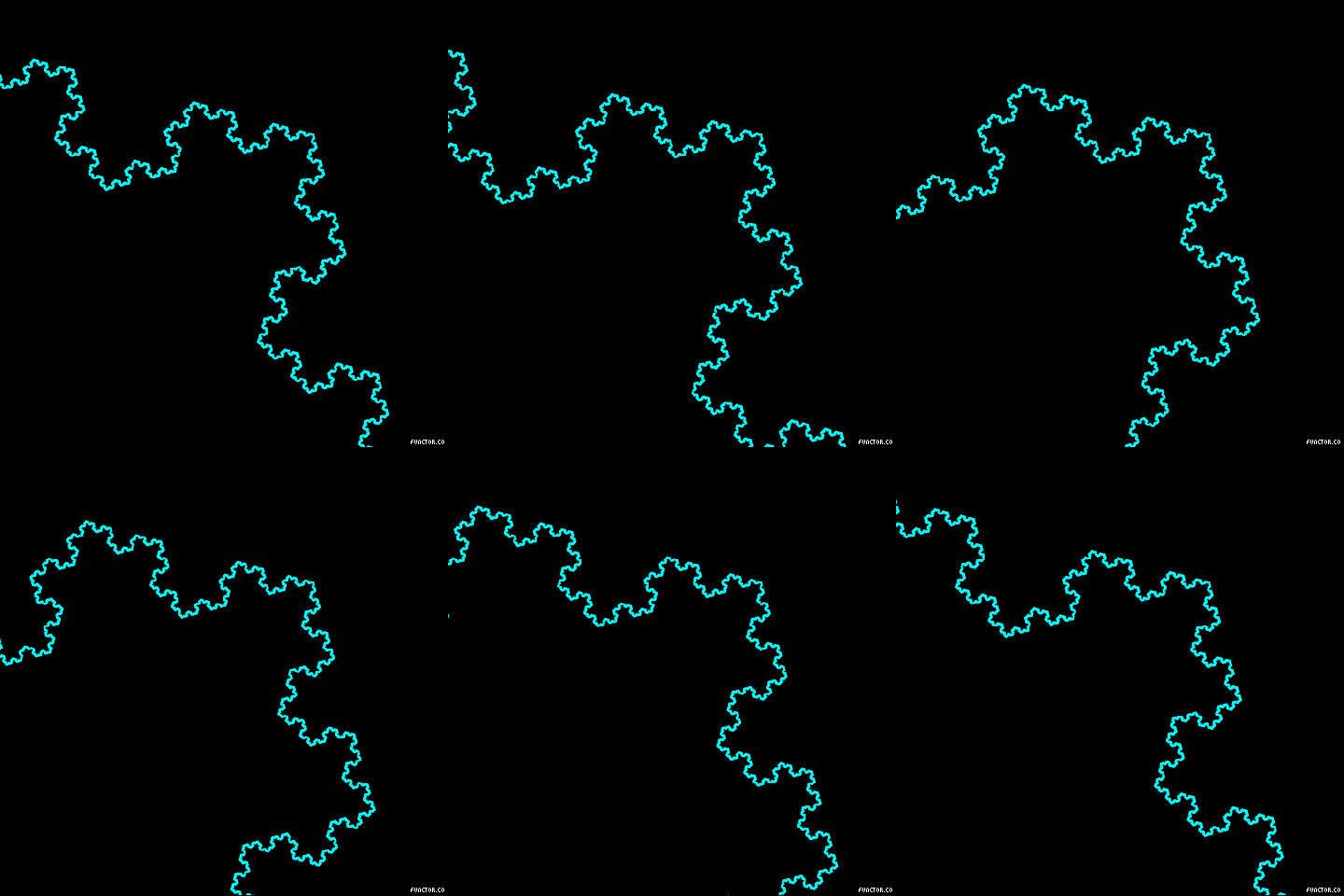

This is a zoom of the Koch Snowflake, one of the most famous fractal designs. It is a mathematical curve which was one of the earliest fractals to be detailed. The Koch Snowflake is a geometric fractal.

Geometric Fractals

Some geometric fractals include the aforementioned Koch Snowflake and the Sierpinski Triangle shown below:

snowflake@2x.gifsierpinski@2x.gif
world.mathigon.org

Let's look at the Koch Snowflake to understand what's happening as it becomes more detailed.

To create a Koch Snowflake:
- Start with an equilateral triangle
- Add a new triangle 1/3 of the size
- Repeat infinitely

The number of sides on the snowflake increases by a factor of 4 after each iteration so after n iterations, the number of sides is:

$N_n = N_{n-1}\cdot 4 = 3 \cdot 4$

The equation for the perimeter of the Snowflake after n iterations is:

$P_n = N_n \cdot S_n = 3 \cdot s \cdot \left (\frac {4}{3}\right)^n$

To create the Sierpinski Triangle:
- Take the midpoints of each side of an equilateral triangle and connect them

Fractals in Nature

One of the most interesting aspects of fractals is that they appear in nature. They are, however, called approximate fractals because they display self-similarity but extend into a finite region. Here are some of the common natural fractals: 

                                From Wikipedia

                                                   From world.mathigon.org

                                                                  From homeandgardenmag.com

Wrapping it up


I hope that you've found the material in this blog interesting. Of course, this is just a scratch on the surface of the fields that are described by these posts.

Mathematics is a fascinating subject which holds more than meets the eye. While these topics may not be relevant in everyday life, they contribute to a description of reality which lies beneath the ordinary. I hope that by reading what is offered here, you will explore more of these topics. While complex, these fields of study help enrich an understanding of reality which every person, no matter their expertise, should be aware of.

Good luck with the constant confusion that lies ahead!

    From theconversation.com

The World of Non-Euclidean Geometry

What's so special about non-euclidean geometry?


Being relatively inexperienced in the many different branch fields of mathematics, I was curious as to how this non-euclidean geometry was different from regular old Euclidean geometry. In order to understand non-euclidean geometry, we must first look at Euclid.

Euclidean Geometry

Euclid is reported to have lived sometime during the 4th and 3rd centuries BCE. He is known as, "the father of geometry." He is also credited with writing the Elements, in which he includes several assumptions. These encompassed his five postulates:


  1. "To draw a straight line from any point to any point."
  2. "To produce [extend] a finite straight line continuously in a straight line."
  3. "To describe a circle with any center and distance [radius]."
  4. "That all right angles are equal to one another."
a. When the lines intersect, and the adjacent angles are equal, each angle
is said to be a right angle

The fifth postulate, however, is what gave rise to non-euclidean geometry:


The parallel postulate: "That, if a straight line falling on two straight lines make the interior angles on the same side less than two right angles, the two straight lines, if produced indefinitely, meet on that side on which are the angles less than the two right angles."


For centuries, mathematicians were puzzled by this postulate. It was complicated but they believed it could be proven from the other four. To attempt to prove it, they subjected it to a proof by contradiction. Their work was unsuccessful in proving the fifth postulate from the the other four, but their efforts were not in vain.


Non-Euclidean Geometry

Kinds of non-euclidean geometry arose from the attempted proving of the fifth postulate, but were not recognized as legitimate until the 19th century. The two main models of non-euclidean geometry that I researched are Elliptic geometry and Hyperbolic geometry.

Elliptic Geometry

From Wikipedia:
"Given a line L and a point p outside L, there exists no line parallel to L passing through p, as all lines in elliptic geometry intersect."

The easiest way to picture such a geometry is to look at a sphere:


Lines in elliptic geometry can be imagined as great circles because all lines in elliptic geometry intersect.


Another way elliptic geometry differs from euclidean geometry is the way figures can be scaled. In euclidean geometry, figures can be scaled up or down and not change shape, i.e. the shapes are similar. In elliptic geometry, however, this cannot be done. Wikipedia explains:


"For example, in the spherical model we can see that the distance between any two points must be strictly less than half the circumference of the sphere (because antipodal points are identified). A line segment therefore cannot be scaled up indefinitely."


The pythagorean theorem also fails in elliptic geometry. In elliptic geometry, the sum of the interior angles of a triangle is greater than 180 degrees. From Wikipedia:


Hyperbolic Geometry

From Wikipedia:
"For any given line R and point P not on R, in the plane containing both line R and point P there are at least two distinct lines through P that do not intersect RThis implies that there are through P an infinite number of coplanar lines that do not intersect R."

These two images from Wikipedia can help with the visualization of the above and of how space works in hyperbolic geometry:


The following image is what a triangle would look like if placed in a saddle shape plane. It also includes two diverging parallel lines:


All images are from Wikipedia


Friday, December 9, 2016

Intro to the Golden Ratio

What is the Golden Ratio?

First, let's calculate it.

We begin with:

$\frac {\phi} {1-\phi} = \frac 1\phi$

We can infer the above equation based on this diagram from Wolfram Alpha:


This is known as a golden rectangle. The golden ratio is denoted by the Greek letter $\phi$

Then we simplify getting:

$\frac {\phi^2} {1-\phi} = 1$

$\to \phi^2 = 1-\phi$

$\to \phi^2 + \phi - 1 = 0$

We then use the quadratic formula:

$\phi = \frac {-(-1) \pm \sqrt {(-1)^2 - 4(1)(-1)}}{2(1)}$

Obtaining:

$x = \frac {1 \pm \sqrt {5}}{2}$

We take the positive version because $\phi$ is defined that $\phi \gt 1$

$x = \frac {1+\sqrt {5}}{2}$  $\to \frac {1+\sqrt {5}}{2} = 1.6180339887 \ldots$

Why do we care about this ratio?

The Golden Ratio has much historical significance. It has been used not only in mathematics but art, architecture, music, and some have even proposed it has a connection to nature and the human genome. Some of the examples below from Wikipedia illustrate how the golden ratio has been used in these different fields.


From Wikipedia
The Parthenon has features suggesting elements of its façade were circumscribed by golden rectangles.

From Wikipedia
Salvador Dalí's painting, The Sacrament of the Last Supper, intentionally includes the golden ratio. The dimensions of the canvas are a golden rectangle and the dodecahedron above Jesus has angles which are in a golden ratio to one another. 

From Wikipedia
This image of the Fibonacci Spiral shows how it approximates the golden ratio. This description from Wikipedia provides an explanation:
"Approximate and true golden spirals. The green spiral is made from quarter-circles tangent to the interior of each square, while the red spiral is a Golden Spiral, a special type of logarithmic spiral. Overlapping portions appear yellow. The length of the side of one square divided by that of the next smaller square is the golden ratio."


Tuesday, November 22, 2016