Studying cool pictures
"In the mind's eye, a fractal is a way of seeing infinity" - James Gleick

What is a fractal?
A fractal is an infinitely repeating pattern at which repeats at different scales. This trait is known as, "self-similarity."
This means that one can keep zooming in on a fractal indefinitely and it will still yield the same pattern.
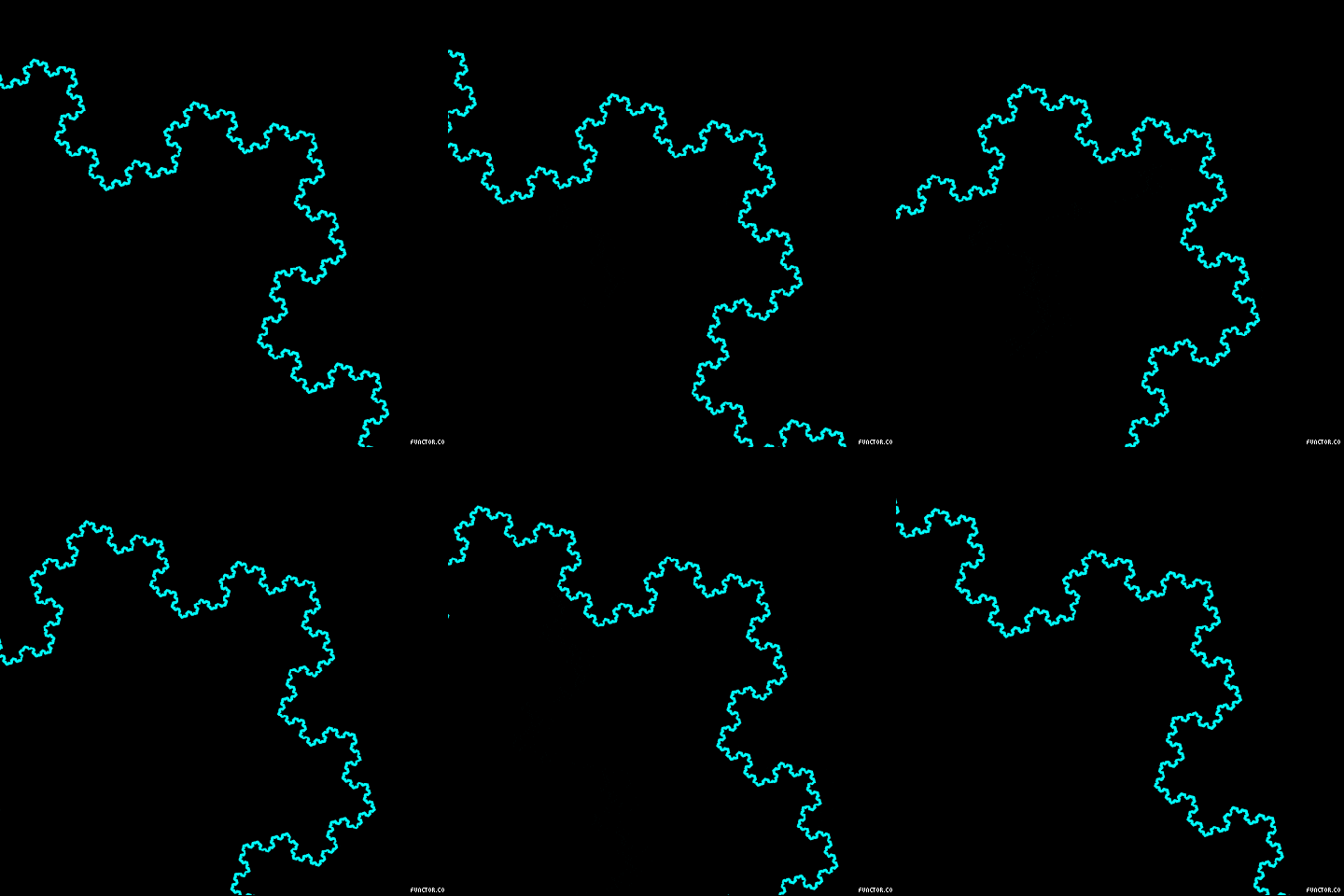
This is a zoom of the Koch Snowflake, one of the most famous fractal designs. It is a mathematical curve which was one of the earliest fractals to be detailed. The Koch Snowflake is a geometric fractal.
Geometric Fractals
Some geometric fractals include the aforementioned Koch Snowflake and the Sierpinski Triangle shown below:


world.mathigon.org
Let's look at the Koch Snowflake to understand what's happening as it becomes more detailed.
To create a Koch Snowflake:
- Start with an equilateral triangle
- Add a new triangle 1/3 of the size
- Repeat infinitely
The number of sides on the snowflake increases by a factor of 4 after each iteration so after n iterations, the number of sides is:
$N_n = N_{n-1}\cdot 4 = 3 \cdot 4$
The equation for the perimeter of the Snowflake after n iterations is:
$P_n = N_n \cdot S_n = 3 \cdot s \cdot \left (\frac {4}{3}\right)^n$
To create the Sierpinski Triangle:
- Take the midpoints of each side of an equilateral triangle and connect them
Fractals in Nature
One of the most interesting aspects of fractals is that they appear in nature. They are, however, called approximate fractals because they display self-similarity but extend into a finite region. Here are some of the common natural fractals:

From Wikipedia

From world.mathigon.org

From homeandgardenmag.com

No comments:
Post a Comment